Teaching problem-solving strategies is just as important as teaching computation. I like to call problem solving, creative thinking, because it feels more positive and less intimidating. After all, the phrase problem solving suggests that there is already a problem!
Story problems require learners to interpret what they are reading, identify important information, and decide where to begin. This can be frustrating, especially when they see numbers and keywords and immediately start calculating without understanding the full story.
I know this struggle personally. Because I am dyslexic, reading all the information is difficult enough. Interpreting it, determining the correct order, and applying inverse operations makes working backward especially challenging.
I start with these sets of directions:
Read every direction carefully before you begin.
Write your first name in the upper-right corner.
Write the number 5.
Add 10 to that number.
Write the number that comes after 99.
Combine the answer to question 4 and question 99.
Smile if you think you got the answer correct.
Take the answer from question 6 and subtract 100.
Stand up, turn around once, and sit back down.
Whisper, “Mangoes are magnificent.”
Draw a box around the answer to question 8.
Ignore directions 2–11. Sign your name at the bottom of the page, turn it over, and wait quietly. Congratulations—you read all the information before deciding where to begin!
GAME: Backtrack
This game gives learners a hands-on way to practice working backward and using inverse operations.
Materials
Counters
One paper bag for each group
Small slips of paper
Pencils
Grouping: Divide students into groups of six or eight.
How to Play
Choose one student in each group to be the Collector. Everyone else receives a small group of counters.
The instructor will give each group a paper bag with the same number of counters. No one is to peek on how many counters are in the bag.
The Collector takes the bag to each player and asks for some counters.
Each player:
Chooses how many counters to secretively add to the bag.
They record that number secretively on a slip of paper.
Turn the slip facedown so no one can see it.
After visiting every player, the Collector counts the counters in the bag and announces the ending total.
The group's goal is to determine what the starting number of counters was in the bag.
Students can:
Turn over the slips and place them in the order in which the counters were added and work it out mathematically
Begin with the ending total, and each student subtracts each contribution in reverse order.
The number remaining should be the mystery starting amount placed in the bag.
Play again but this time each student can choose to add or subtract from the bag and must write on the paper + a number of - a number.
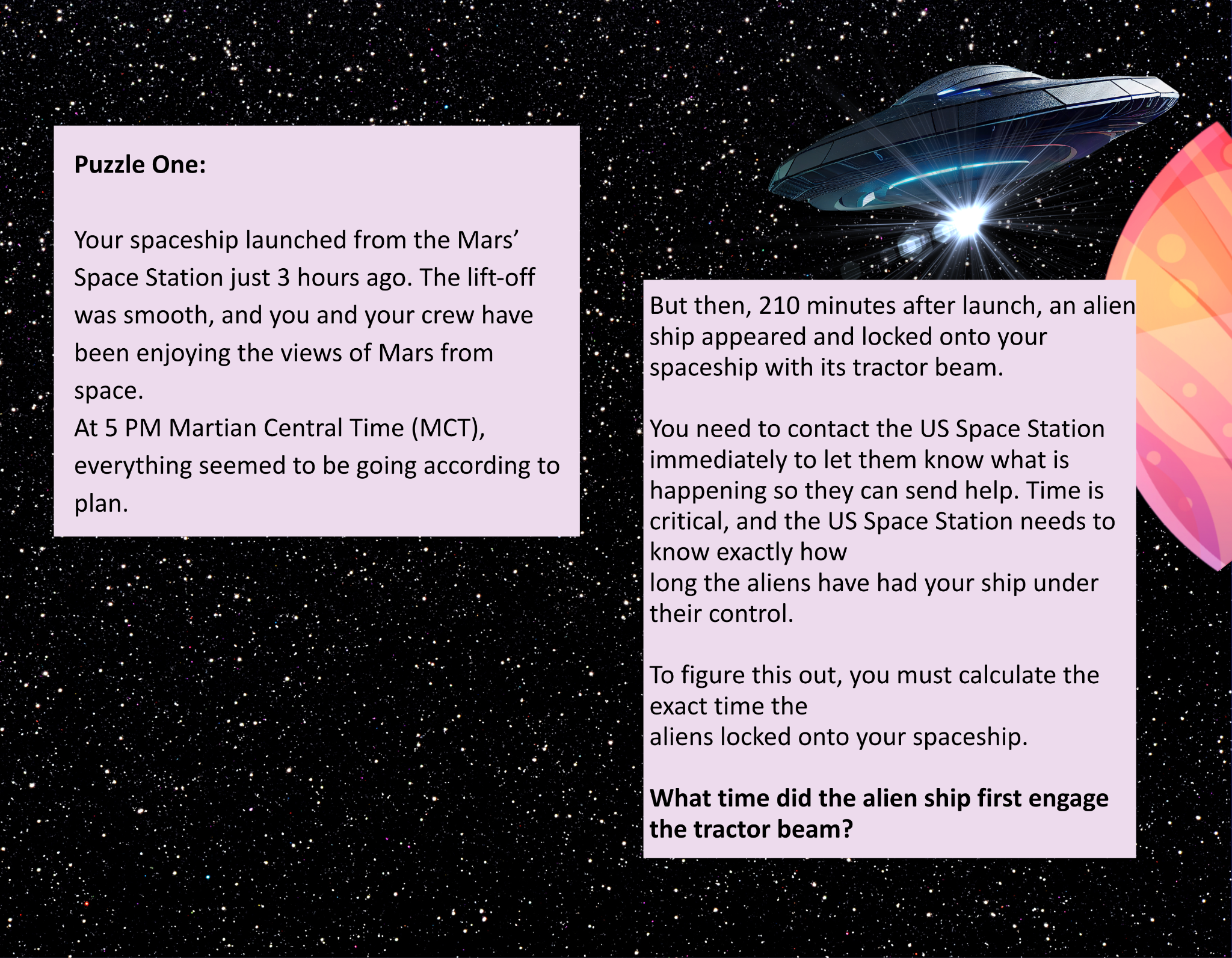
Here is an example of a working backwards problem from our highly rated Add+venture book, Space Escape.


.png)