


Why Transformative Math Is Built on Struggle, Play, and Thinking
Walk into a classroom where real mathematics is happening and you will not see silent rows of children racing through worksheets.
You will see students leaning in debating, testing ideas, making mistakes, trying again.
You will see thinking.
At MANGO Math, we are not just delivering content. We are building mathematical identity. And research strongly supports the principles behind this approach.
Research in motivation science shows that students learn more deeply when they feel autonomy, competence, and belonging. This comes from Self-Determination Theory (Deci & Ryan), which demonstrates that intrinsic motivation increases when learners feel ownership.
When classrooms prioritize curiosity, collaboration, and reflection, students begin to see themselves as capable thinkers, not answer collectors.
The National Council of Teachers of Mathematics (NCTM) has repeatedly emphasized that productive mathematical classrooms focus on reasoning, discourse, and sense-making, not speed or coverage.
Repetition through meaningful experiences, like games played over multiple weeks, strengthens conceptual understanding far more effectively than one-time exposure.
It’s not rush-to-finish.
It’s build-to-understand.
Neuroscience supports what good teachers already know: learning happens in moments of cognitive effort.
Research from Stanford (Jo Boaler and colleagues) shows that when students engage in challenging problem-solving, new neural pathways form. Mistakes and revision activate brain growth. Speed does not.
But not all struggle is helpful.
Productive struggle involves engagement and persistence.
Unproductive struggle leads to frustration and shutdown.
Effective teaching requires noticing the difference. Provide guiding questions when students are thinking. Simplify access when cognitive load becomes overwhelming.
The goal is not to remove challenges.
The goal is to support resilience.
Mathematics is a creative discipline. Mathematicians form conjectures, test assumptions, and revise their thinking.
Research on classroom discourse (Chapin, O’Connor, Anderson) shows that when teachers respond to student thinking with curiosity rather than correction, reasoning deepens. Students who explain and defend ideas retain concepts longer and transfer them more effectively.
When a student suggests a new way to play a game or solve a problem, saying “Let’s test it” invites investigation. That is authentic mathematical practice.
The goal isn't the right answers first.
It’s reasoning first.
The OECD and multiple international assessments have noted that high-performing math classrooms emphasize explanation and inquiry.
When teachers act as facilitators rather than answer keys, students develop metacognition — awareness of their own thinking. Metacognitive skills are strongly correlated with long-term academic success.
Questions such as: “Why does that work?” “How do you know?” “Is there another way?” “What changed?”
These build intellectual independence.
If students believe the teacher owns the answers, they stop owning the thinking.
Here is where the research becomes especially compelling.
Multiple studies in developmental psychology show that hands-on, play-based learning significantly improves conceptual understanding in elementary students.
A 2022 review published in Educational Psychology Review found that guided play produces stronger math outcomes in young learners than direct instruction alone.
Research from the University of Chicago demonstrated that children who used physical manipulatives to explore number relationships showed deeper conceptual retention than peers who used digital-only tools.
The American Academy of Pediatrics has even issued statements supporting play as critical for cognitive development.
Why?
Because physical interaction strengthens neural encoding. Movement, touch, and emotion increase memory consolidation.
Hands-on learning:
In contrast, excessive reliance on screen-based math instruction in elementary grades has been associated with lower conceptual understanding and increased passive learning behaviors. Digital tools can support practice, but they cannot replace physical exploration and social reasoning.
Young brains learn best by doing.
Emotion drives memory.
Joy makes learning stick.
Children do not fall in love with math because it is easy.
They fall in love with math because it makes them feel capable.
When we prioritize:
We are building more than skill. We are building perseverance, curiosity, and confidence.
These are not soft outcomes. They are durable cognitive advantages.
MANGO Math is built around experience, discussion, strategic thinking, and repetition through play. It reflects what research continues to confirm: elementary students learn mathematics most effectively when they are active participants in their learning, not passive consumers of content.
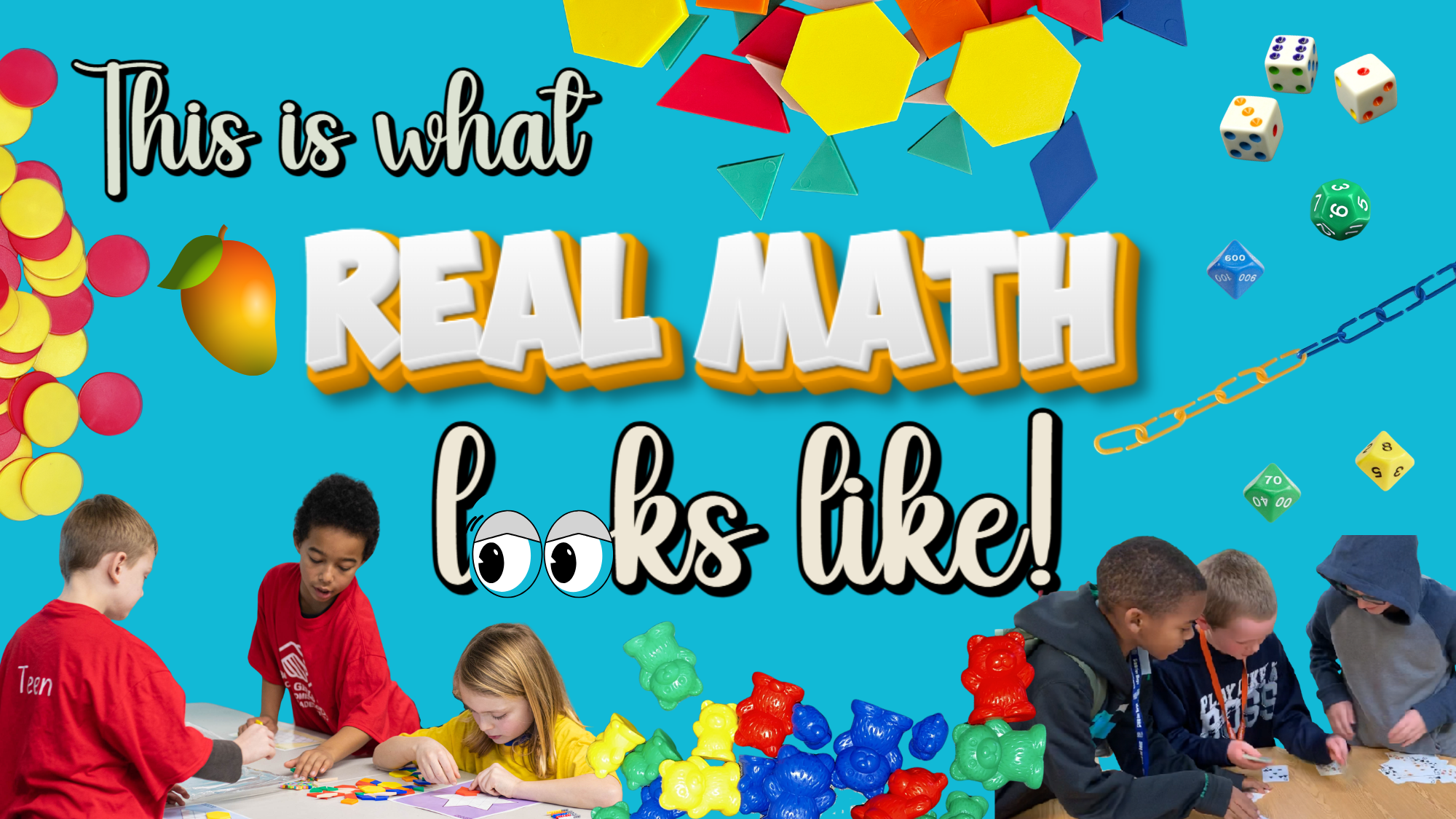
This is what real math looks like.
And it works.

